
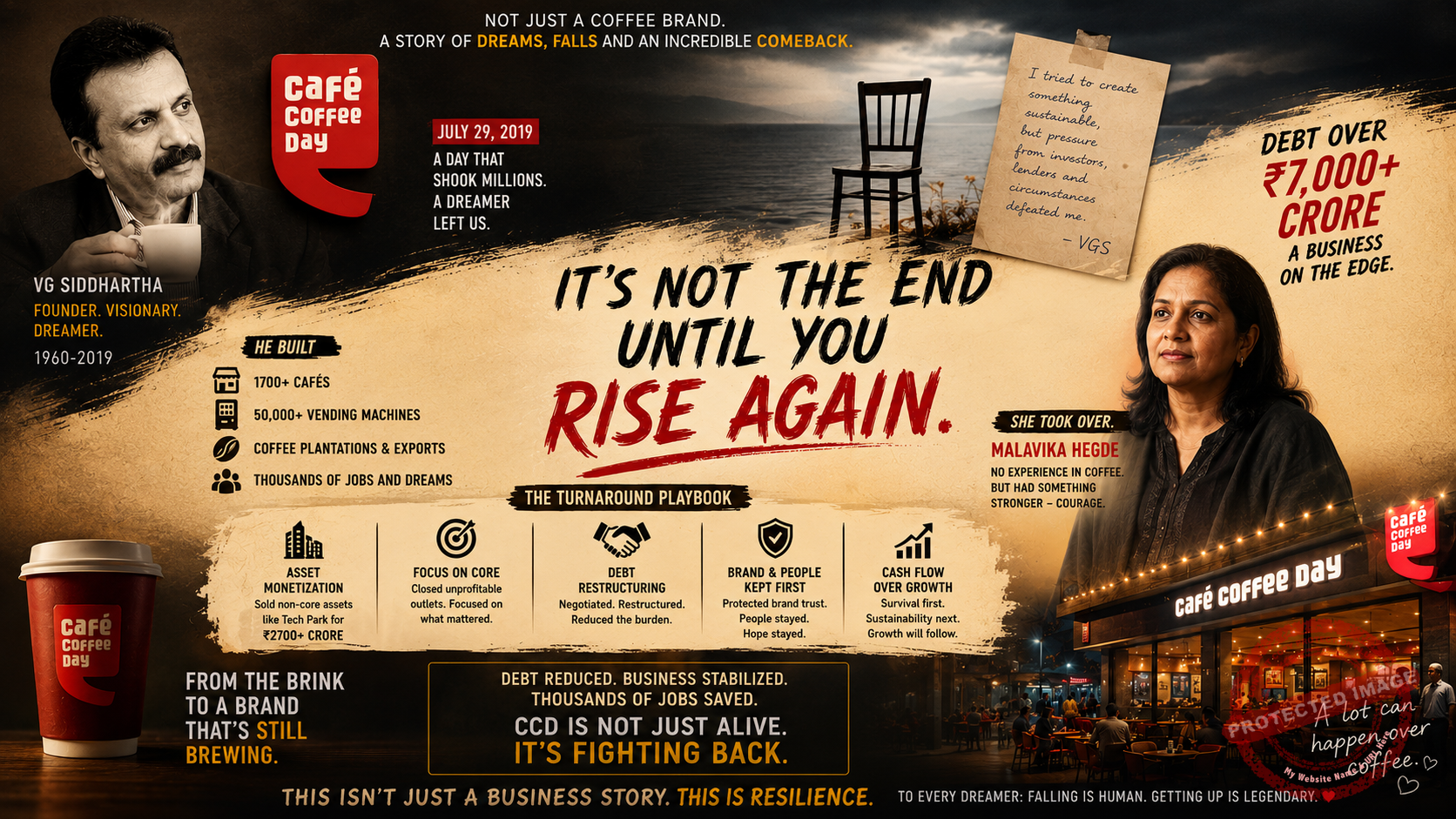
I was going through the Café Coffee Day turnaround story, reading multiple articles, interviews, business discussions, and fragments of public memory.
And somewhere in between numbers, headlines, debt reports, and emotional tributes, one thought stayed with me.
This was not merely a business insider story.
It was a story about fighting back after a fall so public that the entire country witnessed it.
A story about pressure. A story about survival. A story about what remains after ambition collides with emotional exhaustion.
Because there was a time when almost every Indian college student, young couple, startup founder, or exhausted corporate employee had one common memory.
A red coffee mug.
A corner table.
And a simple line that quietly became part of urban India’s emotional culture:
“A lot can happen over coffee.”
Then one day, the country woke up to a different headline.
The founder of Café Coffee Day, V. G. Siddhartha, had died by suicide.
And suddenly, one of India’s most recognizable consumer brands looked fragile.
Not because the coffee stopped.
But because the belief behind it had cracked.
The Day CCD Stopped Feeling Like Just Another Brand
When Siddhartha passed away in 2019, the news did not feel like a business event. It felt personal to millions.
Because Café Coffee Day had grown alongside a generation.
Unlike luxury global chains that sold aspiration from outside India, CCD felt local, accessible, emotional. It democratized café culture before India’s startup ecosystem even exploded.
For many Indians, CCD was the first café they ever entered.
And suddenly the founder’s final reported struggles revealed something much darker behind the smiling storefronts.
Debt. Pressure. Investigations. Investor expectations. Relentless business stress.
It reminded people that sometimes the brightest brands are built by humans carrying invisible storms.
The Day CCD Stopped Feeling Like Just Another Brand
From the outside, CCD looked unstoppable.
Hundreds of outlets. Massive visibility. A strong emotional connection with urban youth.
But underneath the surface, the business had stretched itself aggressively.
The company expanded rapidly across cities. It entered expensive real estate battles. Competition intensified. Consumer behavior changed. Delivery apps reshaped eating habits. Global coffee chains entered deeper into India.
And somewhere in the middle of growth, the numbers became heavier than the optimism.
This is the part most people ignore while discussing entrepreneurship.
Growth is glamorous. Scaling is exhausting.
Every new outlet is not just a celebration. It is rent. Payroll. Supply chain. Operations. Cash flow pressure. Expectations.
The emotional cost of building large businesses is rarely visible in quarterly reports.
The Turning Point Nobody Expected
After Siddhartha’s death, many believed CCD would collapse.
Some thought the brand would quietly disappear. Others assumed lenders would dismantle the business piece by piece.
But something unexpected happened.
The company chose survival over drama.
Instead of loud reinvention campaigns or emotional marketing gimmicks, the turnaround started through disciplined recovery.
And that is what makes CCD’s story powerful.
Not because it became perfect overnight.
But because it decided not to die.
Debt Reduction Became the First Real Victory
One of the biggest challenges was the enormous debt burden.
The company began selling non-core assets. It restructured finances. It focused on survival before expansion.
Slowly, the debt started reducing.
This may sound like a financial detail. But psychologically, it changed everything.
Because once a business stops drowning, it can finally think again.
The noise reduces. Panic reduces. Decision-making improves.
Turnarounds are rarely cinematic in real life. Most recoveries begin quietly. One responsible decision at a time.
CCD Realized It Did Not Need To Pretend To Be Premium
Another important shift happened.
India changed.
The café market evolved. Consumers became more selective. Instagram aesthetics started influencing café culture. Premium coffee experiences grew. Boutique cafés became fashionable.
But CCD still had something many newer brands did not.
Emotional familiarity.
People trusted the brand. They understood it. It belonged to their memories.
Instead of trying to become an artificial luxury experience, CCD slowly repositioned itself around affordability, accessibility, and comfort.
That was a smart psychological move.
Because not every brand wins by becoming elite. Some brands survive because they remain emotionally available.
The Real Lesson Was Never About Coffee
The deeper lesson behind CCD’s story is not business.
It is human pressure.
Modern entrepreneurship often glorifies hustle while silently normalizing emotional collapse.
People celebrate valuations. But nobody sees sleepless nights.
People admire founders. But rarely ask whether they are mentally surviving the weight of ambition.
CCD became a reminder that success without emotional stability can become dangerously lonely.
And yet, the company’s recovery also revealed something equally important.
Institutions can outlive tragedy when people inside them choose responsibility over panic.
That is leadership.
Not motivational speeches. Not LinkedIn quotes.
But showing up when uncertainty becomes public.
Why CCD Still Matters Today
In today’s startup world, businesses rise and disappear every month. Attention spans are short. Consumers move quickly.
Yet Café Coffee Day still carries emotional recognition.
Because it was never just selling coffee.
It sold pause. Conversation. Youth. Hope. First meetings. Last meetings. Lonely evenings. Dreams discussed over cheap cappuccinos.
That emotional archive cannot be replicated easily.
And maybe that is why the brand survived.
Not because the market became easier.
But because millions of Indians had already emotionally invested in its existence.
The Silent Strength of Starting Again
The most inspiring part of CCD’s story is not that it avoided collapse.
It is that the company continued despite carrying grief publicly.
Most organizations hide their pain. CCD had to rebuild while the entire country remembered its darkest moment.
That takes a different kind of courage.
The kind that rarely trends.
The kind that simply continues.
And perhaps that is the real meaning behind the famous line after all.
A lot can happen over coffee.
Including survival.
Closing Reflection
Some brands sell products. A few become memories.
Café Coffee Day became part of India’s emotional geography. And its comeback story quietly reminds us that even after public loss, financial pressure, and emotional collapse, rebuilding is still possible.
Slowly. Painfully. Humanly.
#cafecoffeeday #businessstory #startupjourney #leadershipmatters #brandcomeback