WHEN INSECURITY USES INTELLIGENCE AS A WEAPON — WHAT GITA REVEALS ABOUT HUMAN BEHAVIOR
Sometimes, people praise others… not out of respect, but out of strategy.
Sometimes intelligence is not used to solve conflict. It is used to influence emotions. To trigger reactions. To subtly manipulate decisions.
And often, the most dangerous manipulation sounds calm, calculated, and politically correct.
This is exactly what unfolds in Bhagavad Gita Chapter 1 Verse 2.
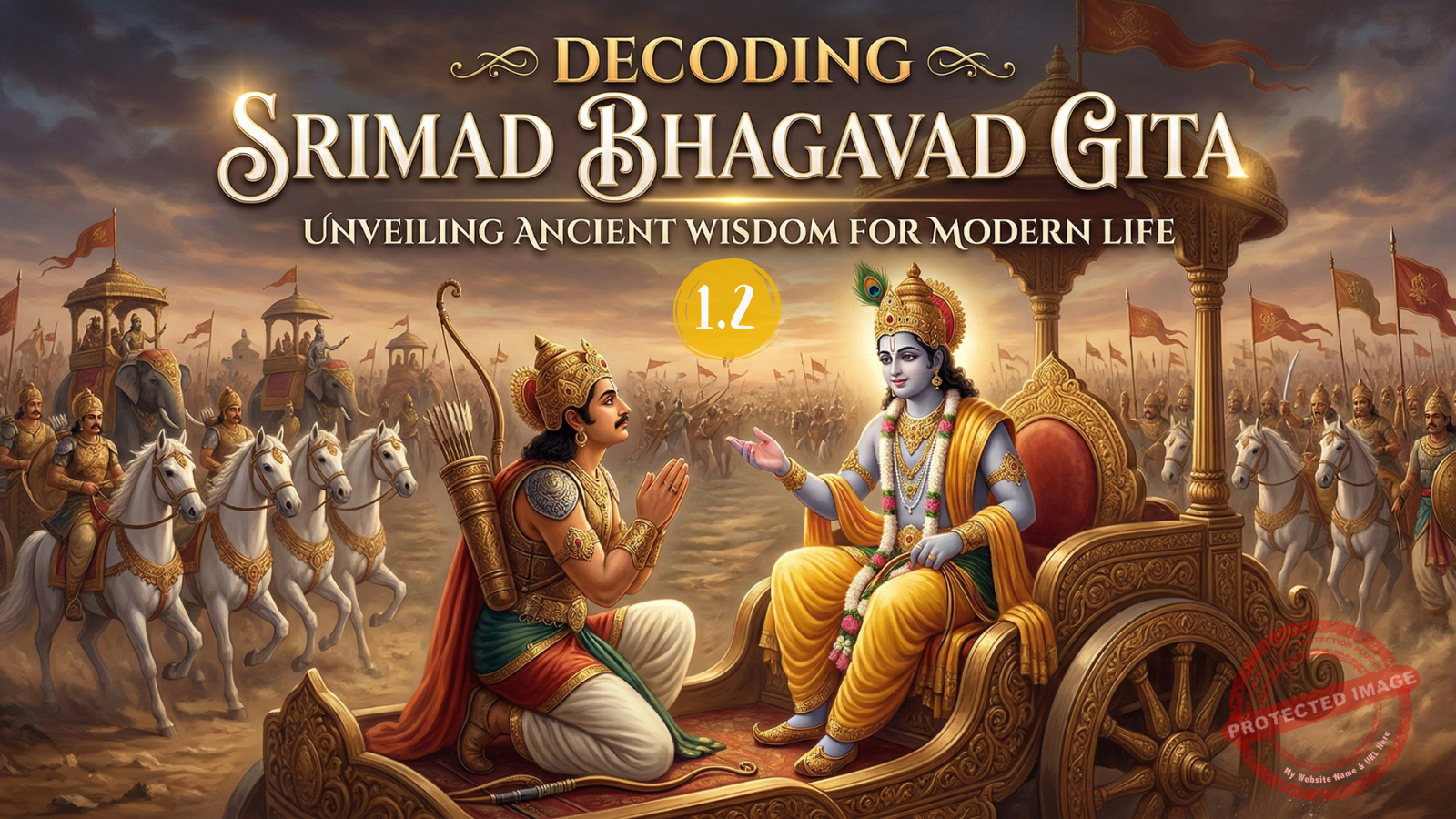
Duryodhana sees the Pandava army. But instead of speaking from courage, he immediately walks toward Dronacharya.
Not to seek wisdom. Not to discuss peace.
But to psychologically position the battlefield.
Before war begins, strategy begins.
And before strategy, insecurity speaks.
THE VERSE
Sanskrit
संजय उवाच। दृष्ट्वा तु पाण्डवानीकं व्यूढं दुर्योधनस्तदा। आचार्यमुपसंगम्य राजा वचनमब्रवीत्।। 1.2 ।।
Transliteration
Sanjaya Uvacha: Drishtva Tu Pandavanikam Vyudham Duryodhanas Tada Acharyam Upasangamya Raja Vachanam Abravit
Meaning
Sanjaya said: “Seeing the mighty army of the Pandavas arranged strategically for battle, King Duryodhana approached his teacher Dronacharya and spoke these words.”
At first glance, this verse appears simple.
But psychologically, it reveals something powerful.
Duryodhana sees strength. And his immediate response is not confidence.
It is calculation.
He walks directly toward the person whose emotions can influence the war — Dronacharya.
This is not merely movement. It is psychological positioning.
BEHIND THE VERSE
Duryodhana was powerful. He had a massive army. He had political influence. He had experienced warriors.
Yet the moment he saw the Pandava formation, his attention shifted.
Because deep inside, strength recognizes strength.
And insecurity reacts instantly when it senses a threat.
But instead of expressing fear openly, Duryodhana chooses strategy.
He approaches Dronacharya carefully. Because Drona once shared emotional ties with the Pandavas.
Duryodhana understands something important about human behavior:
Emotions influence decisions more than logic.
So before discussing war, he attempts to influence emotion.
The battlefield had not started externally. But psychologically, manipulation had already begun.
THE HIDDEN PSYCHOLOGY
1. Insecurity Often Hides Behind Confidence
Duryodhana appears confident externally. But his actions reveal inner disturbance.
Truly secure people do not panic at the sight of competition.
But insecure minds react quickly when they encounter competence, strength, or discipline.
Modern life is filled with similar behavior.
People act arrogant, controlling, or politically smart… not because they are fearless, but because they are internally threatened.
2. Manipulation Begins Through Emotional Positioning
Duryodhana does not randomly approach Drona.
He chooses the exact person whose emotions matter.
This is psychological strategy.
People often try to influence outcomes by first influencing emotions.
In workplaces:
people flatter seniors, trigger guilt, play loyalty cards, create emotional pressure, or subtly shape narratives.
Not always to serve truth. But to control direction.
3. Intelligence Without Ethics Becomes Dangerous
Duryodhana is not foolish. He is intelligent. Strategic. Observant.
But intelligence without ethical grounding becomes manipulation.
And modern society often rewards this.
Corporate politics. Narrative management. Emotional persuasion. Selective storytelling.
The problem is not intelligence. The problem is intention.
4. Threat Changes Human Behavior
The moment people feel threatened, their communication changes.
Their body language changes. Their tone changes. Their strategy changes.
Fear rarely announces itself openly. It quietly transforms behavior.
That is exactly what this verse captures.
REAL WORLD APPLICATION
In Leadership & Work
This verse plays out daily inside organizations.
The moment a capable new team appears, insecure leadership reacts.
Not always aggressively. Sometimes strategically.
Suddenly:
meetings increase, alliances form, narratives shift, credit politics begin.
Why?
Because insecurity fears replacement.
Some leaders mentor talent. Others try to emotionally control it.
This verse exposes the psychology behind workplace politics.
In Relationships
People often manipulate emotionally when they fear losing importance.
Guilt. Silence. Passive aggression. Emotional positioning.
Not because they are evil. But because insecurity seeks control.
Many relationship conflicts are not caused by lack of love. They are caused by fear of losing emotional power.
Within Ourselves
We all have moments of inner Duryodhana.
Moments where:
comparison triggers insecurity, competition creates anxiety, someone else’s growth feels threatening.
And instead of confronting fear honestly, the mind starts creating strategy.
Excuses. Narratives. Emotional positioning.
This verse asks us to observe:
Do we respond to strength with inspiration… or insecurity?
THE DEEPEST LESSON
Bhagavad Gita Verse 1.2 reveals a timeless truth:
Insecurity becomes dangerous when combined with intelligence.
Because fear with power does not stay silent. It becomes strategic.
Duryodhana teaches us that not every calm voice is peaceful. Not every intelligent action is ethical.
Sometimes, the sharpest manipulation is hidden inside composed behavior.
And the moment fear begins influencing intelligence, truth becomes secondary.
QUESTIONS FOR SELF-REFLECTION
Pause and ask yourself:
- Do I feel uncomfortable when I see someone capable or growing?
- Have I ever tried to emotionally influence situations instead of addressing truth directly?
- Do I use intelligence for clarity… or for control?
- When threatened, do I become honest… or strategic?
- Am I building confidence internally, or managing insecurity externally?
FINAL REFLECTION
The battlefield of Kurukshetra is not only about war.
It is about the human mind under pressure.
And Verse 1.2 reveals what insecurity looks like when dressed in intelligence.
Duryodhana did not react emotionally. He reacted strategically.
And that is what makes this verse psychologically profound.
Because modern life is filled with polished manipulation.
In boardrooms. In politics. In relationships. Even within ourselves.
People rarely reveal fear directly. They hide it inside influence, control, and calculated communication.
The Gita begins by showing us something deeply uncomfortable:
The mind becomes most dangerous when intelligence serves insecurity instead of truth.
If this reflection resonated with you, stay with the journey. If any interpretation feels incomplete or inaccurate, I genuinely welcome deeper insights from fellow learners.
#appliedgita #leadershipinsights #lifeandwork #conflictresolution #selfawareness #emotionalintelligence #decisionmaking #growthmindset #bhagavadgita #indianwisdom